The Police Baton Through Time: From Traditional Wood to Modern Steel Gear
For centuries, the silhouette of a law enforcement officer has been defined by a few iconic symbols. Perhaps the most enduring of these is the baton. Long before the advent of modern electronics or chemical irritants, the simple wooden stick served as a badge of office, a tool for communication, and a formidable means of defense. The history of the baton is not just a chronicle of changing materials; it is a reflection of the evolving philosophy of policing itself, a journey from the heavy, hand-carved clubs of the Victorian era to the high-tech, retractable steel and polycarbonate tools used by elite teams today.
The Era of the Wooden Sentinel
In the early days of professional policing, the wooden straight baton was the primary instrument of the trade. Known by various names, billy clubs, truncheons, or espantoons, these tools were often crafted from dense hardwoods like hickory or ash. In the Victorian era, these were more than just weapons; they were regal symbols of authority. It was common for English truncheons to be beautifully decorated with the Royal coat of arms, signifying that the bearer was acting on behalf of the Crown. Officers often took great pride in their batons, sometimes marking them with family crests or their own initials, turning a standard-issue tool into a personal heirloom.
The utility of the wooden batons extended far beyond physical altercations.
Officers used them to tap out rhythmic signals on the pavement to communicate with colleagues blocks away, to direct the flow of horse-drawn traffic, and to safely guide or detain suspects without resorting to lethal force. In American cities like Baltimore, the “espantoon” became a legendary part of the local police culture. Officers were famous for their ability to twirl these large wooden sticks with mesmerizing dexterity as they walked their beats. This display was not merely for show; the constant, rhythmic twirling served as a visual reminder of the officer’s presence and readiness, often diffusing potential conflicts through the mere implied threat of disciplined force.
However, the strength of the wooden baton was also its greatest liability. These tools were incredibly sturdy and, in the hands of an untrained or overly aggressive individual, could cause significant injury, including broken bones or concussive trauma. While departments generally discouraged strikes to vulnerable areas, the sheer mass of the wood made every impact heavy with consequence.
A Shift in Perception and Correctional Technology
The cultural landscape began to shift dramatically in the mid-20th century. During the 1960s, the visual of the straight wooden baton became inextricably linked with the televised images of social unrest. As the public watched police use heavy clubs during the Civil Rights movement, the “big stick” began to lose its status as a symbol of protection and started to be viewed through a more critical lens. This shift in public perception, combined with a desire for more versatile tools, led to the first major redesign of the baton in decades.
By the early 1970s, it was clear that law enforcement needed a tool that emphasized defense and control over blunt force. This gave rise to the side-handle baton, most famously exemplified by the PR-24. Introduced to American agencies in 1972, this design featured a handle perpendicular to the main shaft, inspired by traditional martial arts weapons. This wasn’t just a new shape; it was a new philosophy. The side handle allowed an officer to hold the baton like a splint against the forearm, creating a powerful shield to block incoming strikes. The unique “Y” gap formed between the handle and the shaft also allowed for sophisticated control techniques, enabling an officer to safely secure a suspect’s wrist or arm.
While the side-handle baton required significantly more training to master than the traditional straight stick, it offered a level of versatility that was previously unthinkable. It moved the baton away from being a “beatdown” tool and toward being a sophisticated instrument of self-defense and tactical control.
The Retractable Batons Revolution
As the 20th century progressed, the physical demands on a police officer’s duty belt began to increase. With the addition of radios, handcuffs, and eventually early less-than-lethal options, space became a premium. The traditional long baton was often cumbersome, banging against the legs during foot pursuits or getting snagged when entering a patrol car. The solution arrived in 1976 with the founding of companies focused on expandable technology.
The expandable metal baton revolutionized the field by offering the reach of a traditional baton in a package that collapsed to just a few inches. Usually made of high-grade steel, these batons could be deployed with a flick of the wrist, a sound that itself became a psychological deterrent. The transition from wood to steel allowed for a thinner, lighter profile. This reduced weight allowed officers to deliver faster, multiple strikes if necessary, though it did come at the cost of the “one-hit” stopping power found in heavier wooden or solid models. To address this, some manufacturers developed “weighted” or more robust versions of the collapsible baton to provide more kinetic energy during an encounter.
Despite these advancements, the late 20th century also saw the rise of alternative less-than-lethal technologies. The introduction of TASER weapons and pepper spray offered officers ways to resolve conflicts from a distance, leading many to leave their batons behind. The baton required close proximity and, increasingly, a higher level of legal and tactical justification for its use compared to other tools.
Modern Gear Innovation and the Crowd Control Gap
In the 21st century, the role of the baton has found a new and critical specialization in the realm of crowd control and rapid response. While everyday patrol officers may rely on electronic devices, specialized units facing volatile situations require equipment that provides both physical protection and a clear defensive barrier. Interestingly, much of the riot gear used today has not seen a significant overhaul since the 1970s, leaving a gap between the needs of modern officers and the technology available to them.
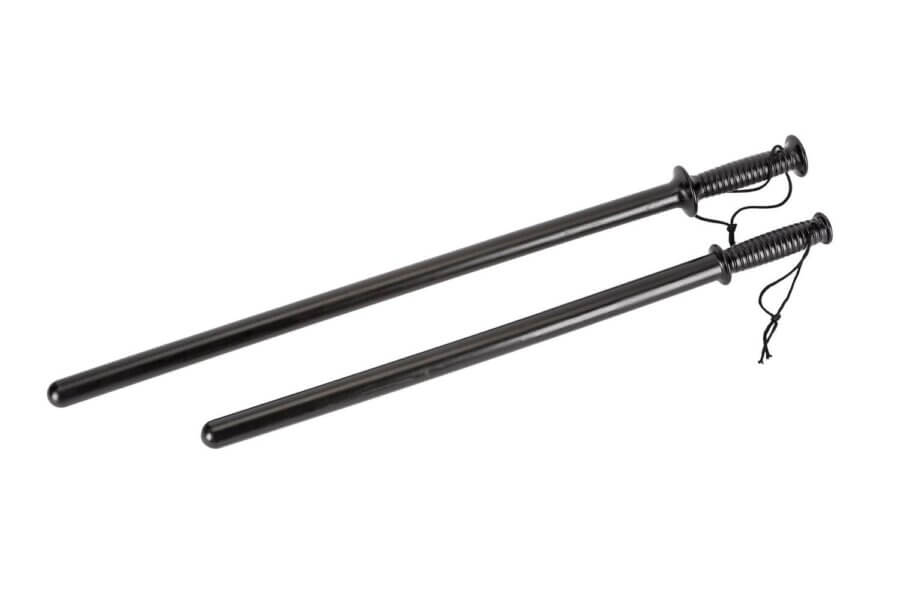
This is where companies like Haven Gear have stepped in to redefine the standard. Recognizing that many traditional riot suits and accessories were heavy, hot, and restricted mobility, Haven Gear focused on developing a new generation of defense technology. Modern riot batons have evolved into high-performance tools made from materials like polycarbonate. These batons, often available in 28-inch or 34-inch lengths, combine the lightweight benefits of modern polymers with incredible durability.
Polycarbonate straight batons represent a return to the simplicity of the original wooden designs but with the benefits of 21st-century engineering. They are virtually indestructible, weather-resistant, and designed to work in tandem with modern full-body suits. This evolution ensures that when officers are called to diffuse dangerous situations, they have tools that are as flexible and versatile as the tactics they are trained to use. The focus has shifted entirely toward the safety of the officer and the public, with companies like Haven Gear prioritizing riot gear that is mobile enough to allow for quick reactions while being durable enough to stand up to the harshest conditions.
Frequently Asked Questions
Why did police switch from wood to steel or polycarbonate?
The switch was driven by a need for durability and versatility. Wood can crack or warp over time and carries a heavy weight. Steel allows for collapsible designs that save space on the duty belt, while polycarbonate offers extreme durability and impact resistance in a lightweight form, which is essential for long shifts in riot or crowd control situations.
Is the baton still a relevant tool in modern policing?
Yes. While TASERs and pepper spray are common, they are not always effective or appropriate. The baton remains a reliable mechanical tool that does not run out of batteries or get affected by wind. It is particularly vital in crowd control, where it can be used for “pushing” maneuvers and creating space, which electronic tools cannot do.
What is the difference between a straight baton and a side-handle baton?
A straight baton is a traditional cylindrical tool used for striking and basic control. A side-handle baton (like the PR-24) has a perpendicular handle that allows for more advanced defensive blocks and joint manipulation techniques, though it requires more specialized training to use effectively.
How long are modern police batons?
The length varies by use. Expandable batons for patrol usually range from 16 to 31 inches. Straight batons used for riot control are typically longer to provide better stand-off distance, with common lengths being 28 or 34 inches.
Conclusion
From the hand-polished hickory of the 19th-century beat cop to the precision-engineered polycarbonate tools of today, the police baton has survived as one of the most resilient pieces of equipment in the law enforcement arsenal. Its evolution tells a story of a profession that is constantly learning, adapting, and seeking better ways to balance the necessity of force with the priority of safety.
While the materials have changed, from wood to steel and now to advanced polymers, the core purpose remains the same: providing officers with a reliable, less-than-lethal means to protect themselves and the communities they serve. As technology continues to advance, the baton will likely continue to evolve, but its place as a symbol of the disciplined professional will undoubtedly remain. Whether it is a collapsible steel unit on a patrol belt or a high-impact polycarbonate baton in a specialized response kit, this tool remains a cornerstone of tactical safety.