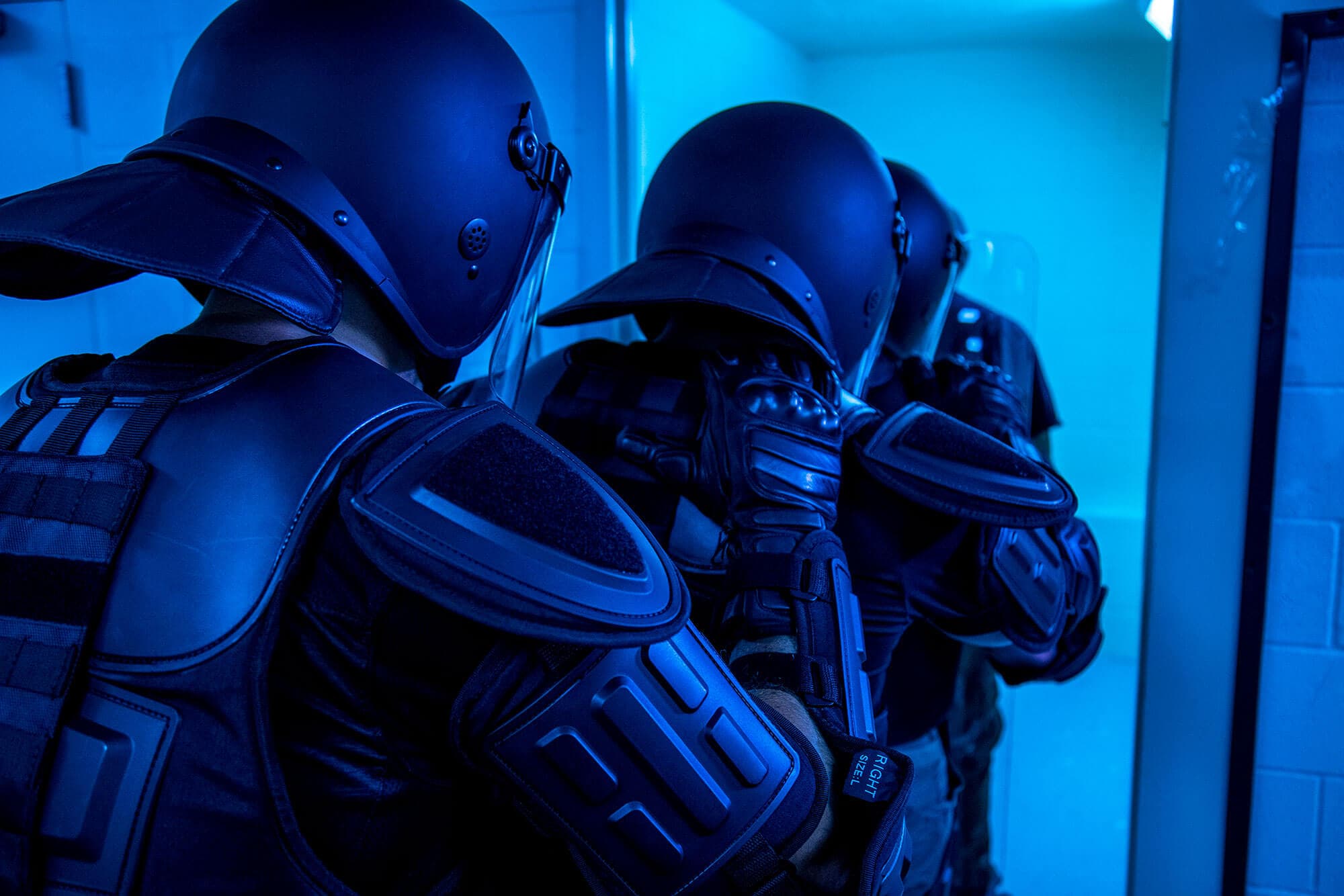
Prison riot response is not the same tactical problem as street crowd control. The threats are at closer range, the environment eliminates standoff distance, improvised weapons are more common than thrown objects, and the officer-to-subject ratio is typically much lower. Gear that works well in an outdoor line formation may be inadequate or actively counterproductive in a corridor or cell block.
The Confined Space Problem
A full riot shield is useful in an open environment where officers can maintain formation distance. In a narrow corridor, a large shield reduces mobility and can become a liability when an officer needs to move quickly through a doorway or around a corner. Stab and slash threats from improvised weapons are the primary concern in a correctional response, not thrown projectiles. Suit coverage needs to address that threat profile specifically.
The Department of Justice has documented the distinct injury patterns in correctional facility incidents compared to street crowd control, noting that stab wounds from improvised weapons represent a higher proportion of officer injuries in confined facility responses.
What Gear Addresses This
The Haven Gear Enforcer MP includes spike armor compatibility in its integrated ballistic carrier, which is specifically relevant for correctional extraction scenarios. Full limb coverage is critical: hands, forearms, and lower legs are the most exposed areas in close-quarters contact, and the coverage that matters most at distance (torso) matters less at the range where improvised weapon strikes actually land.
The Riot Limb Set provides the extremity coverage that correctional officers need in rapid-response situations where putting on a full suit is not possible before entry. Helmet with face shield is non-optional in a confined space response regardless of what other gear an officer is wearing.
Donning Time in a Facility Response
Correctional incidents often develop faster than the staging time a street crowd control deployment allows. Officers need to be able to put on their protective gear quickly, without a partner, in a limited space. The Enforcer MP's self-dressing design addresses this directly. Officers who train with the gear consistently and have a practiced donning sequence are significantly faster than those who suit up infrequently. T&E evaluation gives correctional units the opportunity to assess donning time under realistic conditions before making a purchase decision.